
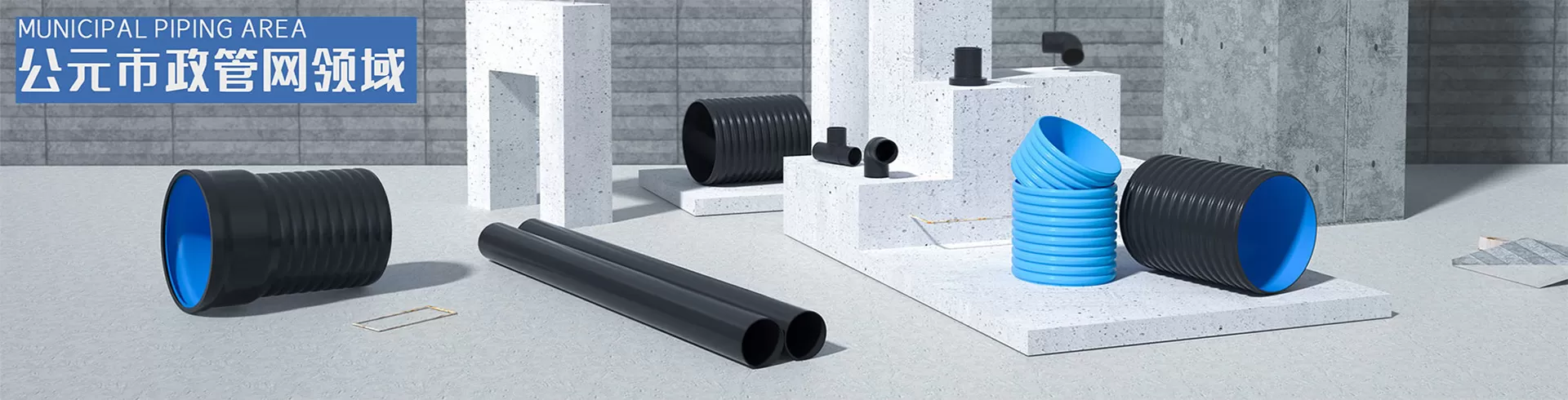
In the field of modern fluid transportation, the application of large diameter PE pipe is becoming more and more extensive. As a key characteristic, the smoothness of its inner wall has a significant impact on the energy consumption of transportation.
From the principle of hydrodynamics, the smoothness of the inner wall directly affects the resistance of fluid flow. When the inner wall of the PE pipe is smoother, the frictional resistance of the fluid flowing in the pipe is smaller. This is because the smooth inner wall reduces the microscopic bump contact between the fluid and the pipe wall, allowing the fluid to pass through the pipe more smoothly.
In order to quantify this effect, we can introduce the concept of resistance coefficient. Through experimental and theoretical calculations, we found that the resistance coefficient decreases by a certain percentage for each increase in the smoothness of the inner wall. Assuming that under the same conveying conditions, such as conveying medium, flow rate, pipeline length, etc., the reduction of the resistance coefficient will directly lead to the reduction of the conveying pressure.
The conveying pressure is directly proportional to the energy consumption. According to the law of conservation of energy, the energy required to transport the medium (energy consumption) is equal to the product of pressure and flow. Therefore, when the drag coefficient decreases, the conveying pressure decreases, and the energy consumption will also decrease under the condition of constant flow.
For example, in an actual water supply project, large-diameter PE pipes with different inner wall smoothness are used. After a period of operation monitoring, we compared two sets of data: one is a pipeline with average inner wall smoothness, and the other is a pipeline with higher inner wall smoothness. The results show that the energy consumption of the latter is significantly lower than that of the former. Through further data analysis and calculation, we can obtain the specific energy consumption reduction ratio, which is the quantitative analysis of the inner wall smoothness and transportation energy consumption of large-diameter PE pipes.
This quantitative analysis is of great significance for engineering design and cost control. When selecting large-diameter PE pipes, considering the smoothness of the inner wall can effectively reduce energy consumption and save operating costs while ensuring the conveying effect. At the same time, it also provides the direction for pipeline manufacturers to improve product quality, that is, to enhance the competitiveness and market value of products by improving the smoothness of the inner wall.
Overall, there is a clear quantitative relationship between the smoothness of the inner wall of large-diameter PE pipes and the energy consumption of transportation. In-depth study and understanding of this relationship is of great practical significance for promoting the development of the plastic pipe industry and optimizing the fluid transportation system.


